Showing posts with label television. Show all posts

Monday, April 27, 2009

What is Classical Conditioning and How is it Used Today?

Classical conditioning is a psychological process defined by the Oxford Dictionary as “a learning process that occurs when two stimuli are repeatedly paired: a response that is at first elicited by the second stimulus is eventually elicited by the first stimulus alone.” In social terms, it is a learning process that leads people to unconsciously respond to a stimulus, such as a message, an advertisement, a warning, or the news, in a way that is taught. In more explicit terms, it can be a form of manipulation. In Brave New World, the society uses conditioning to manipulate the castes of citizens so that they involuntarily learn to consume commercial items and to enjoy being in their caste level. For example, using electroshock therapy, a form of classical conditioning, babies are shocked when they touch books and flowers to create an aversion to them. This way, they will grow up to have an irrational fear of nature and books, and thus will spend more time consuming products instead of enjoying nature or education.

People can be conditioned to have fears in the real world too. The television is a powerful means of communicating messages to people, with 98% of American homes having a television as of 1985 (Singer & Singer, 224). Americans rely on televisions increasingly for entertainment. In 1950, the average American household watched 4.5 hours of television a day (Singer & Singer, 226). Now that figure has increased to 7.25 hours a day (Singer & Singer, 226). The implications of this increased time spent watching television is that people are more and more influenced by what they watch. The messages that these endless hours of television offer people are usually exaggerations of the real world, which thus creates an illusion for viewers. This illusion is often of a more exciting and dramatic world to entertain viewers. However, when these false portrayals of society are repeatedly shown, viewers become classically conditioned to expect the world to resemble what they see on television.



The News Spreads Fear of Violence

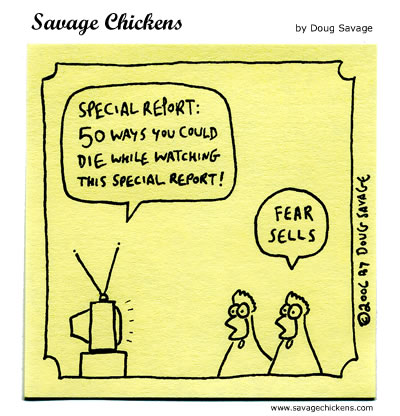
The news is an influential medium that plays a huge role in conditioning Americans. With 35 million nightly viewers, it is considered a trusted informant on the worlds events (Radford, 66). A problem with Americans using the news as their source of current events is that the reported stories are decontextualized and filtered through a journalist, which adds a bias to the stories. Not everything newsworthy makes it onto the news. What often does make it onto the news are crimes, sometimes bumping more important news off the air. A study done by Professor Joe Angotti from the University of Miami concluded that 30% of news air time is spent on crime, 15% is on the government and politics, 7% is on medicine and health care, and 2% is on education (Radford, 69). The disproportionate coverage of crime conditions people to fear crime more than they should. The more violence people watch on TV, the more conditioned they will be to perceive the world as violent. 

By emphasizing crimes and violence, the news spreads a false image of the world to viewers. For example, in 1994, a Time magazine article ran a headline across the top of two pages that read, “Not a month goes by without an outburst of violence in the workplace--now even in flower nurseries, pizza parlors and law offices” (Glassner, 26). Following this story, more than five hundred stories came out about violence in the workplace in 1994 and 1995 alone (Glassner, 27). Fear of random attacks by coworkers spread across the country. It was not until a journalist from The Wall Street Journal, Erik Larson, discovered the actual statistics that the myth of a workplace crisis was dispelled (Glassner, 27). He found that included in the scary statistics that newspapers were proliferating was the deaths of the most vulnerable workers: police, security guards, and taxi drivers, to name a few. Taxi drivers alone have a “homicidal rate twenty-one times the national average” (Glassner, 27). The news can spread false or exaggerated information to the public using misleading data. 


The Victims and How They Tell Americans Who to Fear

          As mentioned before, the news has the power to choose what information the public sees. This means that the newscasters decide which stories and victims get air time. One of the most common groups of victims on television is children, considered by Professor David Altheide as “a critical symbol in the entertainment-oriented fear perspective” (Altheide, 156). Between the years 1994 and 1996, 28% of Los Angeles Times headlines that contained the word “fear” had the word “children” in the article (Altheide, 158). One reason for the media’s emphasis on child victims is that nearly everyone supports the protection of children and opposes crimes to children such as pedophilia, abduction, abuse, etc, so the news stories appeal to a wide crowd. However, an effect of widespread coverage of crimes against children is that it conditions Americans to expect an unreasonably high amount of child victims.

       White people are another group that are over-represented as victims on the news.  Black people are most often reported as the perpetrators and not the victims, even though black people are much more commonly the victim (Glassner, 109). A classic example of the inadequate coverage of crimes with black victims is the Kent State shootings versus the Jackson State shootings. At Kent State, police shot at a crowd of anti-war protesters, killing four and wounding nine. At Jackson State, a historically black college, police shot at anti-racism protesters and killed two and injured twelve. Even though the Jackson State shootings were only ten days after the Kent State shootings, and they were very similar in nature, Kent State got much more media coverage than Jackson State. Without adequate coverage of crimes against all races, Americans will be conditioned to believe that whites are the most victimized race. In addition, the underrepresentation of black victims perpetuates the stereotype that blacks are dangerous. If black victims were actually portrayed as victims on the news, they would be humanized to viewers, receive more viewer sympathy, and possibly dispel some of the fear surrounding minorities. 

Just as repetition of news stories with white or child victims has conditioned Americans to fear minorities as perpetrators of crimes, the repetition that only citizens of the “brave new world” are civilized has conditioned Lenina to fear the “Savages.” The first word Lenina said when she arrived at the Reservation was “queer,” identified by Bernard as her “ordinary word of condemnation” (Huxley, Ch. 7). As they made their way through the pueblo, Lenina regurgitated conditioned lines, such as “cleanliness is next to fordliness,” and scorned the Savages for not adhering to her conditioned beliefs about what a society should be like.


Monday, April 13, 2009

Annotated Bibliography

Glassner, Barry. Culture of Fear: Why Americans are Afraid of the Wrong Things. New York: Basic Books, 1999.


Very good source with helpful references and index. 276 pages.

This book goes beyond the obvious and digs deep into television's many effects on Americans’ fears. Glassner uses specific news stories to prove that stories are often exaggerated or told incorrectly. Case stories and extensive research are evidence that television has a role in creating magnified fears of child molesters, cyberpredators, teen gambling, and even black men.


Altheide, David L. Creating Fear: News and the Construction of Crisis. New York: Aldine de Gruyter, 2002.


Excellent source with substantial references and useful index. 223 pages.

This insightful source highlights the nature of fear in our lives and argues that the media magnifies our “lens of fear,” or our fear-tainted view of the world. It narrows in on how particular organizations such as the military, television interviewers, and newspapers capitalize on spreading fear. Altheide explains that the use of fear as entertainment cause the growing perception that the world is hazardous, violent, and unsafe.


Singer, Dorothy G. and Jerome L. Singer. Handbook of Children and the Media. Thousand Oaks: Sage Publications, Inc., 2001.


Excellent source with extensive bibliography and index. 765 pages.

This text is very straightforward and easy to navigate. The authors support their information about televisions and their effects with statistics and psychological experiment results. Especially relevant are the chapters “Effects of Televised Violence on Aggression” and “The Media and Children’s Fears, Anxieties, and Perceptions of Danger.” The former gives useful background information about the influence of television on Americans. The latter delves into the psychological impact of television on children and uncovers the role media plays in children’s worries and anxieties. 


Howe, Michael J. Television and Children. London: New University Education, 1997.


Insightful source with useful bibliography and index. 157 pages.

As a psychologist, Howe has a lot to offer on the topic of television’s effect on children. His text draws a useful connection between television and learning. He describes children as John Locke would: savages with no knowledge of their society’s culture, or a blank slate. He asserts that television as a large component of children's’ learning about the world and culture and defines three ways that television effects viewers: effects on behavior, effects on knowledge, and effects on attitudes.


Radford, Benjamin. Media Mythmakers: How Journalists, Activists, and Advertisers Mislead Us. New York: Prometheus Books, 2003. 


Outstanding source with extensive bibliography and index. 324 pages.

This text provides a revealing look at the news and its motives. Chapter 3, “The News Bias,” is particularly useful because it provides background statistics that show that the news reports a disproportionate amount of crimes, leaving other important topics, such as education and health care, underrepresented. The effect of biased and disproportionate news is that people fear crime and tragedies more than they should.